Showing posts with label Dublin. Show all posts

28.10.12

Ireland’s Bastille

Sunday, 20 May 1900 - Dublin, Ireland

Today I was on a particularly dangerous mission for the University of Dublin. Well, dangerous for me, anyway. The University was very keen on me getting inside the infamous Kilmainham Gaol (“jail” to you Yanks.) They wanted me to record what the palce was like while it was in operation.

Kilmainham Gaol as it looks now in 1900
I could easily get into this maximum security prison by robbing a bank, but the University decided that me impersonating a vicar would be enough. They falsified papers for me so I could not only get in, but be allowed to get back out. So I became a visiting vicar wanting to spend Sunday ministering to someone since I didn’t have a congregation available.

When I quoted Matthew 25:36 which says Christians should minister to prisoners, the guard looked bored. Apparently I was not the first. Indeed I was not the only person there wanted to preach to inmates. We were told to stay in the main hall and speak through the bars. They also frisked us for weapons to make sure none of us was there to aid in an escape. I think we were only tolerated because they hoped we might reform an inmate or two.

As I came into the huge oppressive-looking atrium of the East Wing lined with three stories of cells, it made me feel very small. The depression was palatable. I looked at the other ministers who had been here before, admiring their courage, for even though I knew I was going to get out today, I knew I would have nightmares about this place.

East Wing of Kilmainham Gaol
I went closer to the locked cells full of thieves and murderers. “Excuse me? Would anyone like to speak with a vicar?”

I might as well have said, would anyone like to cuss out the Englishman. The prison is run by the government which is based in London. So I silently let the half dozen who heard me vent.

When they settled down I said, “If you must know, I am in favor of Home Rule. Ireland is your country, you should be allowed to run it.”

Then I heard a voice. “Vicar! Over here!”

I stepped over, keeping the foot distance we were instructed by the guards to keep, least we be grabbed and injured. I knelt down to peer through the little door just large enough to pass a bowl of food. I expected to see looking back the face of a brute who had murdered his family, but instead found a pair of soulful blue eyes on a young face.

“Yes, my son?” I tried to sound priestly. “What may I do for you?”

“Can you get a message to my mother and sister? Let them know I’m okay?”

“They don’t let you write?”

“Yes, but an eyewitness might put them more at ease. They know I would say I was fine whether I was or not.”

“All right.” I pulled out a pad and paper. “Let me get the address.”

“I’m sorry about all those names I called you, Vicar. It’s just--well--it’s just that Home Rule is why I’m here.”

The young man told me his name was Sean Kane and proceeded to tell me how on the night Queen Victoria arrived in Dublin, Maude Gonne had organized a torchlight parade to protest British rule. It was meant to be a peaceful demonstration, but Dublin officials had no tolerance for anything but niceties toward Her Majesty. The police stormed the protestors beating them with batons to chase them off.

The Sean’s voice tightened. “One of those blighters took a swing at my sister. I stopped him by hitting him in the eye. I got six months for assaulting an officer. I was told I got off easy.”

Yes, as I said Kilmainham is a maximum security prison full of thieves and murderers. It is also where all political prisoners have been brought since it first opened in 1796. Indeed just about every Nationalist leader, both violent and peaceful, has been a “guest” in this prison. I hadn’t expected to find any political prisoners here in 1900. Apparently just no famous patriots are here right now.

Many political prisoners were released after they had been taught a lesson. Some were hanged. This is the prison all the rebels in the Easter Rising of 1916 were brought. Out in the courtyard is where the fifteen leaders will be executed by firing squad without a proper trial. (I mention this in my blog on the Easter Rising.)


In 1924 the Irish Free State will close down Kilmainham Gaol. Torn between tearing down this symbol of foreign oppression or preserving it as the site of so many martyrdoms, Ireland will let Kilmainham sit and rot for decades. Finally in 1971, after years of restoration, the former prison will be opened as a museum to the fight for freedom.

The Sean said he wasn’t sorry for protecting his sister. He also wasn’t sorry he protested. From the sound of his voice I had a feeling he would return to Kilmainham Gaol after the Easter Rising. I’m happy to say Sean’s name is not on the list of those that will be executed.

After talking an hour with Sean I left that dreadful place. I did visit his mother as I had promised. I noticed his sister looked in good health. She told me tearfully she had only been able to escape because of her brother’s sacrifice. I told her Sean Kane would be remembered. Indeed he will when I return to the 27th century with our interview. I wondered how many other forgotten heroes have stayed in Kilmainham Gaol?

26.10.12

The Treasonous Act of Loving Ireland

Friday, 18 May 1900 - Dublin, Ireland

Today I ran across the strangest memorial I have ever seen. High on a stone pedestal is a ten foot marble statue of a gentleman in a frock coat, arms folded in a noble stance. Nothing strange there. What is odd is the inscription. It’s in Gaelic but beneath it is an English translation which reads:

William Smith O’Brien
born 17th October 1803,
sentenced to death for high treason
on the 9th October 1848.
Died 16th June 1864.
 

“High treason?” I said aloud. “Why would they erect a ten foot memorial to a traitor?”

“O’Brien no traitor!“ snarled a voice. “His act of treason was loving Ireland.”

I turned to see an gentleman with a white beard. “Oh hullo, sir.” I smiled at him. “Do you know the story of this O’Brien chap?”

“Indeed I do! I helped erect this statue back in 1870. All paid for by folks like me given what they could. All patriotic Irishmen!” He glowered at me.

“Yes, my accent is English, isn’t it. What if I told you my parents immigrated from Dublin to London when I was a babe and I came back to find my Irish roots?” That’s a question, not a statement. I don’t like lying; I prefer misdirection.

The man’s expression softened. He now assumed I was Irish. “This is a good place for your education to start--with O’Brien. He descended from the great Irish king Brian Boru himself. Definitely inherited his ancestors courage and nobility, that’s for sure.”

“I would certainly love to hear his story. May I buy you a cup of tea?”

The man, who introduced himself as John Lyons, accepted my offer, and told me this amazing tale.

William Smith O’Brien was the son of a well-to-do Irish baronet. He was educated at the University of Cambridge. For twenty years he was a Member of Parliament and originally a conservative pro-unionist. But then the Irish famine came in 1845 and O’Brien like many others became disillusioned with being part of a kingdom where certain parts were left to starve. Parliament seemed apathetic, some seeing this as a way to solve what they perceived as Ireland’s over-population problem.

In 1848, the year of rebellion throughout Europe, Ireland really had something to rebel about with the famine only getting worse. O’Brien joined with Thomas Francis Meagher to incite a revolt. It led to one battle with police which ended the rebellion. O’Brien was captured and put on trail and found guilty of high treason. He was sentenced to be hanged, drawn and quartered.

Petitions for clemency signed by 70,000 Irish and 10,000 English stopped the execution. After all the battle was short and nearly bloodless. O’Brien had killed no one. Besides the sentence seemed a wee bit too medieval. Instead he was sent to the prison colony of Tasmania for life. Five years later O’Brien was released but banished from Ireland for life. After two years in Brussels, he was given and unconditional pardon and allowed to return to Ireland. He was barred from politics though.

William Smith O'Brien
Although the revolt was a failure, his fellow Irish men saw William Smith O’Brien as a hero, for he was willing to sacrifice everything for his fellow countrymen. He had come from the privileged class and could have lived a very cushy if he had just ignored the plight of the starving poor.

After O’Brien died people began collecting money to build a monument to him in. His statue isn’t hidden in a park, but stands in the middle of busy Sackville Street (later named O’Connell Street.) The plaque doesn’t say “hero” or “valiant leader” which probably made the authorities happy. It doesn’t need to. Every Irishman knows who this William Smith O’Brien is. Someday Dublin will be full of statues to all the leaders of Irish rebellions against England. However, this is the very first one. Erecting this statue to a rebel was an act of rebellion in itself.


21.10.12

St. Werburgh's Church

Sunday, 13 May 1900 - Dublin, Ireland

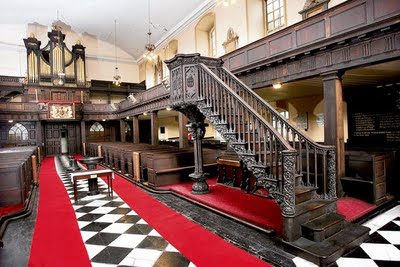
Today I attended the service at St. Werburgh’s Church here in Dublin. The current building was built in 1719, the church itself dates back to 1178. While it now belongs to the Church of Ireland (the Anglican church of Ireland) it could be argued St. Werburgh’s was an “Anglican Church” from the very start. Built just after the arrival of Anglo-Norman into Dublin, it was frequented by immigrants from Bristol.

St. Werburgh's Church entrance
Even the church’s name is Emglish. St. Werburgh or Werburga was the daughter of the 7th century King Wulfhere of Mercia. She became the abbess of Ely in Cambridgeshire, following in the footsteps of her mother, grandmother and great aunt. Werburgh was well loved in life and after her death a large cult formed around her. Several churches are named for her, but the one here in Dublin is believed to be the oldest.

Steeple per 1810
The church has had several modifications. In 1754 a fire damaged the interior and it was replaced in 1759. In 1777 a lofty steeple was added, then removed in 1810, the rest of the tower in 1836. The authorities said the fire had damaged the steeple making it unsafe. Some believe the tower overlooking Dublin Castle, made the Lord Lieutenant nervous. There had been those revolts in 1798 and 1803 after all. Or perhaps he feared the ghost of Lord Edward FitzGerald whose body lies in an ancient crypt beneath the church might use the advantage point?

Lord Edward FitzGerald was born in 1763, the fifth son of the Lord of Leinster. Wealthy, educated, highborn and handsome, Edward had a cushy life to look forward to. Pheasant hunting was not his style, though. He entered the British military reaching the rank of major, dabbled in politics as a Member of the Irish Parliament, and even explored the New World where he was adopted by the Hurons.

Then in 1792 FitzGerald ventured to Paris and lodged with a revolutionary named Thomas Paine. Having inspired the American Revolution, Paine was now working on the French. Paine didn’t hold it against FitzGerald that he had fought for the Brits against the Americans in their Revolution. FitzGerald was inspired by Paine. A year later he returned to the Irish Parliament, defending the Society of United Irishmen who wanted more independence from Great Britain. At that point they were hoping for constitutional reform. By 1896 both the United Irishmen and FitzGerald gave up and decided to follow the example of America and France.

Lord Edward FitzGerald
Lord Edward FitzGerald, descended from Norman conquerors on his father’s side and great-great-grandson to King Charles on his mother’s, put his lot in with the poor downtrodden of his country and became a leader of the Irish Rebellion of 1798. When the French allies failed to turn up and things went bad, FitzGerald turned down the chance to escape, staying with his men. He was shot while resisting arrest and subsequently died of his untreated wounds before he could be officially executed. The rebellion not only failed to make Ireland independent, but gave the opposite side the excuse to absorb Ireland into Great Britain as the United Kingdom.

Ironically Town-Major Henry Sirr, the man who arrested Lord Edward FitzGerald is buried in the church’s graveyard.

Besides St. Werburgh’s most famous burial,it’s most famous baptism is probably that of Jonathan Swift, who became Dean of St. Patrick’s Cathedral. Swift though is better remembered for his satire, Gulliver’s Travels.

Even with her lofty steeple and tower lopped off, St. Werburgh’s still a grand old lady. Her heritage permeates from her ancient foundations. Her namesake would be duly impressed with her church.

interior of St. Werburgh's Church
Follow @SaintWerburghs Church on Twitter

19.10.12

Special Delivery

Friday, 11 May 1900 - Dublin, Ireland

Today I visited the General Post Office on Sackville Street here in downtown Dublin. Built between 1814 and 1818, it is the last great Georgian structure in Dublin. The grand columns are like a temple to the goddess of postal service. Indeed there are three statues on top of the roof: Mercury, the god of commerce, to the left; Fidelity, symbol of faithfulness, to the right; and in the middle, Hibernia, the personification of Ireland, holding a harp. I’m not sure what Fidelity has to do with mail, unless the GPO is promising to deliver packages to their rightful owners.

General Post Office on the left as it looks in 1900
It’s a very nice and grand post office as befits a large city, however it is an ordinary boring post office. People take the mail to clerks who take it to a backroom to be sorted and sent out for delivery. Ask an Irishman in a hundred years and he will tell you this stodgy institution is in fact the birthplace of the Irish Republic.

Right now there is a push for Home Rule, the reestablishment of the Irish Parliament. They are slowly winning over the majority who want to keep the Union as it is. When I say majority, I mean a majority of the wealthy and powerful who run the country. Nationalists pushing for a complete break from Great Britain and independence are a small minority.

1914, just as Ireland was on the brink of getting Home Rule, World War II broke out and dreams of an Irish Parliament were shelved. The real majority, the poor Irish Catholics, saw this as just another excuse, but decided to be patient.

1916 came and still no action. Several nationalists organizations got together to form a revolution. While the British army was busy overseas, now would be the perfect time to strike. On the 24th of April, the day following Easter Sunday, the rebels captured key buildings throughout Dublin. The buildings were taken without much fight from the civilian population. The centrally located General Post Office would serve as their headquarters. The flag of the Irish Republic was hoisted above the roof. The leader Patrick Pearse, came out on the steps and read the Proclamation of the Irish Republic.

flag hoisted over the General Post Office
When the rebels made it public that the Germans had given them their guns, England panicked. This was more than just a troublemakers, this was the Germans trying to attack Britain from two fronts! The British sent 16,000 soldiers to deal with the 1200 rebels. The Post Office and other buildings were bombarded and downtown Dublin went up in flames. 64 rebels were killed along with nearly 300 innocent bystanders.

British troops shelling the General Post Office in 1916
By Saturday it was all over. Rebels were told to surrender unconditionally. They were marched to Kilmainham Gaol while crowds jeered and threw garbage at them. Then the stupidest thing Britain could have ever done happened. Martial Law was proclaimed and General Sir John Maxwell was put in charge.

Maxwell was a military man who knew nothing of politics or public opinion and treated Dublin as an enemy camp. A total of 3,430 men and 79 women were arrested. Trials were held behind closed doors. The accused were not allowed defense, with Maxwell as the judge and jury. 187 trials were held in three weeks, as many as thirty in a day. By the 12th of May fifteen men had been executed by firing squad. The first was the school teacher, Patrick Pearce. The last was James Connolly, so badly wounded he had to tie him to a chair. A list of 90 men convicted to be shot was tacked on the door.

Burnt out Post Office after Easter Rising
If the rebels had been handed over to the police and then put on public trial, things would have been very different. As it was Dublin saw this as an assault against the liberties of all Irishmen. Didn’t citizens of the United Kingdom deserve their civil rights--or were the Irish not included? Suddenly those ruffians they had booed became martyrs in their eyes and the dream of an independent Irish Republic not that crazy after all.

By the time Prime Minister Herbert Asquith showed up and put a halt to any more executions, the damage had been done. Ireland no longer trusted Britain. In the next election in 1918, the Sinn Fein, the nationalist party, won 73 of the 105 seats that Ireland held in the United Kingdom House of Parliament. Instead of showing up for work in London, the Sinn Fein MPs formed the Dail Eireann, Parliament of Ireland, and declared Ireland a republic. That in turn led to the Irish War of Independence. This time the rebels had the backing of the majority of the people.

In 1925 the new independent Irish Free State will be left with the still burnt-out shell of their former post office. Should they tear it down and build their new parliament on this now sacred ground? Maybe a shrine would be more applicable? Instead they will decide the best idea will be to turn it back into a post office and try to recreate it as best they could. The only reminder will be a plaque on the wall in Gaelic and English; a statue of the mythic Celtic warrior, Cuchulainn (made five years before the Easter Rising;) and paintings of scenes from the uprising up on the walls.

As I stood in the very spot Cuchulainn would one day occupy, I glanced about at all the busy customers rushing to get their letters mailed. I wondered what they would think if I told them that one day this post office would have a special delivery for them--freedom.


"The Dying of Chuculainn" by Oliver Sheppard
Now in the General Post Office in Dublin
So, what does a mythic warrior have to do with rebels? In Irish legend Chuculainn held back an entire army. He knew how much he was feared so he tied himself to a menhir so his enemy wouldn't know when they had killed him. They only knew when a raven sat down on his dead form and began pecking out his eyes. His sacrifice however won time for his people to defeat their enemy.
 
By putting this statue in the Post Office, the Irish are comparing the martyrdom of the rebels with Cuchulainn's martyrdom. The leaders Patrick Pearce and James Connolly knew full well they would probably not win and would be executed as the ring leaders, but felt their sacrifice would spur the public into demanding freedom. It isn't a coincidence they set the date Easter Monday.
 
Footage and photos of the Easter Rising

9.10.12

My Visit to Golden Age Ireland

Tuesday, 1 May 1900 - Dublin, Ireland

St. Kevin's Church
It’s May Day, the modern equivalent of the ancient Celtic festival of Beltane, the beginning of summer according to the ancient calendar. Beltane was celebrated with a big bonfire back then. I decided to celebrate with my own Temporal Tuesday trip into the distant past--the Golden Age of Ireland.

Just south of Dublin in the Wicklow Mountains is Glendalough, literally Glen of Two Lakes. It was here that Kevin (Coemgen in Gaelic) started a hermitage in the sixth century. Kevin was a monk at Kilnamanagh, now the neighborhood of Tallaght in Dublin, but then decided to become a hermit.

Glendalough - Glen of the Two Lakes
Kevin is said to have been led to this valley by angels to a cave that was originally a Bronze Age tomb. Here he lived wearing animal skins, eating nettles, praying and having a good time. Then others heard of this holy man and came to him to be taught his wisdom. Unfortunately Irish etiquette dictated Kevin had to honor their request and soon he had a monastery full of monks. Rather difficult to be a hermit so many people underfoot.

Kevin tried sneaking off to be a alone again, but the monks dragged him back, begging him to lead them. He gave up and served as their abbot until his death of extreme old age. Legend says he lived to be 120.

Glendalough continued to grow in influence, becoming one of the major places of pilgrimage. It also had a school teaching aspiring monks and nobility alike. Glendalough was just one of many monasteries with schools throughout Dark Age Ireland. The Emerald Isle became famous throughout Europe for it’s learning. Charlemagne, when trying to establish a new Holy Roman Empire, made sure to invite Irish scholars to his court.

Glendalough however soon became overshadowed by a growing Dublin. In 1398 an English army partially destroyed Glendalough and it became a backwater. In a way that was a blessing, for it put the valley out of the notice of the far more destructive Cromwell and William of Orange.

Round Tower
A surprising amount of the ancient monastery survives. Not sure if any dates back to Kevin, but certainly back more than a thousand years. The 98 foot tower is still intact. All right, the roof was reconstructed in 1876, but they used the original stone. The door is 12 feet off the ground so monks could climb in using a ladder and pull the ladder after themselves to keep out of reach of Viking raiders. A Dark Age panic room.

There are several churches in various degrees of ruin here, but the best preserved and probably oldest is St. Kevin’s “Kitchen.” It’s really a chapel. It was so well built that last century it was “restored” by sweeping out and adding wooden pews for worship.

Further up the valley on the banks of the Upper Lake is St. Kevin’s Bed, the cave he originally lived in. It was worth the hike to see it. The scenery is so lovely the trek was most pleasant in itself. St. Laurence O'Toole (Lorcán Ua Tuathail), the abbot of Glendalough in the 12th century, used to sleep here, too. He was later made Archbishop of Dublin, then a largely Viking town, who approved his appointment, making him the first Irish Bishop of Dublin. It was probably not very respectful of me, but I couldn’t fight the urge to lie down in the spot I assumed the two saints had laid. It filled me with wonder, but mostly with pain from that stone in my back. Not at all comfortable. I do hope the poor chaps at least had some straw.
 
St. Kevin's Bed Cave
Kevin will not be made an official saint until 1903. Back in 618 when he died, canonizing wasn’t a common practice yet. He will not only be considered a saint by the Roman Catholic Church, but by the Orthodox Church and the Anglican Church as well. Of course he has always been considered a saint here in Ireland even while he was still alive.

I hung about the Glen of the Two Lakes until I was forced to catch the last train back to Dublin. I must say spending your entire life in this beautiful valley would hardly be a hardship. Kevin picked well.

Rick Steves visits Glendalough
(as well as Powerscourt Estate I saw last week)

4.10.12

Her Majesty Departs Dublin

Thursday, 26 April, 1900 - Dublin, Ireland

Today with much relief (and perhaps a little sadness) Dublin bid farewell to Her Majesty Queen Victoria. The whole thing has been a bit like a stuffy but very wealthy aunt showing up on your doorstep and wanting to stay for a couple of weeks. You dare not turn her out and do your best to please her.

This time Her Majesty exited Dublin a bit more quietly than she entered. Instead of the parade through town, she took the train from Kingsbridge station just outside Phoenix Park down to Kingstown. When Her Majesty’s carriage arrived at the station from Viceregal Lodge, Princesses Beatrice and Helena were the first to exit. Her Majesty then got out leaning on her cane and her Indian servant, Abdul Karim. I had the feeling the large man fought the urge to just pick the tiny woman up like a child and set her down on the platform, but that would not have been dignified. He hovers over her like she was his own mother.


Kingsbridge Railway Station
Looking well, Queen Victoria wore a corsage made of green shamrocks, the symbol of Ireland. Despite being under five foot and frail with age, Her Majesty still can emit serenity and strength. She was greeted by several dignitaries, including the Mayor and his wife; Mr. Joshua Pim, Chairman of the Great Southern & Western Railway; and Mr. Frederic Pim, Chairman of the Dublin, Wicklow and Wexford Railway. (I’m assuming the two Pims are related.) Her Majesty bowed to them and said “I am very sorry to leave Ireland. I have had a very pleasant time.”

An hour later I watched the Royal Yacht disappear over the horizon followed by a flotilla of battleships as the Queen of the United Kingdom and Empress of India returned to England. The Lord Mayor seemed relieved that everything had gone well. The Queen had a lovely visit and no one had tried to assassinate her. And she left him a very nice present--a knighthood.

Viceregal Lodge in Phoenix Park where Her Majesty stayed
Her Majesty’s visit has stirred up strong emotions among the citizens of Dublin. On one end, patriotism for Unionists and on the other, resentment among Separatists. Queen Victoria has been blamed for poverty and prejudice. She made a point of acknowledging Catholics and the poor this visit, trying to make them feel they too belong.

The truth is the most powerful woman in the world has very little power. It’s the Prime Minister and the Parliament that really run the show. Victoria is nothing more than a figurehead raised in an ivory tower. However she has been closer to her people and their problems than any of her predecessors, thanks to Prince Albert. The Victorians wanted both a middle-class wife and mother as well as a larger-than-life demigoddess. Victoria did her best to pull them both off. I think we should give the little lady and little credit.

 
In 1904, King Edward VII will visit Dublin to unveil this memorial to his mum, created by Irish sculptor, John Hughes. After the Irish Independence, all statues of British kings will be gleefully blown-up, except for this one. Instead the old girl will be shipped off to Sydney, Australia where she will be given a good home.

27.9.12

Dublin's Private Garden

Thursday, 19 April 1900 - Dublin, Ireland

Quiet day for Her Majesty as she recovers from the last few days. I took the opportunity to visit another Guinness landmark--Iveagh House (pronounced “eye-vee.”) Since it’s now a private residence, I just visited the outside of the house.

Iveagh House
Iveagh House is in fact two buildings built in the 1730s. Those were very prosperous years for Dublin and several Georgian townhouses were built in this section of the city. In 1862 Sir Benjamin Lee Guinness, 1st Baronet and grandson of the founder of the Guinness Brewery, bought Numbers 80 and 81 on St. Stephen’s Green and combined the two houses, putting a Portland stone facade on the front to make it seamless. The home has since passed to his son, Edward.

As beautiful as Iveagh House is, the real gem is what lies behind it-- a garden covering several acres hidden by stone walls. I couldn’t help but peer through the gates at it. I didn’t see the distinguished-looking middle-aged gentlemen slip up beside me. “Would you like a look?” he asked.

I apologized for my rudeness but assured him I would like nothing better. “Do you know the owner?”

Lord Iveagh
“Quite intimately. It belongs to Lord Iveagh and I am he.”

“You are Edward Guinness, the Earl of Iveagh?”

He frowned. “No, the Baron of Iveagh.”

Oops, nearly blew that one. That won’t be for another nineteen years. They will keep heaping titles on Edward and it wasn’t for his hobnobbing with influential people. He is well remembered for all his many philanthropic works. One project was clearing out the slums and replacing it with decent but affordable housing for the poor. “Yes, of course. My name is Dr. Wendell Howe and I am very honored to meet you.”

“Medical man?”

“Historian. I understand these gardens goes back nearly a hundred years.”

“Actually they are older. The gardens originally belonged to John Scott, the 1st Earl of Clonmell, and Lord Chief Justice of the King's Bench for Ireland back in the 1780s. I’m not sure if who named them the Saxe-Coburg Gardens.”

“Yes, after the current Royal Family. Very patriotic.”

Lord Iveagh nodded. “I’m afraid the gardens had fallen into a terrible state when my father, Sir Benjamin, bought them in 1863 to go with his new house. Father hired a garden designer named Ninian Niven. Did an excellent job. Would you like a tour?”

Would I! I of course took him up on his offer. I know we must have strolled through it for at least a couple of hours as he showed me all the details. The garden has grottoes, rose gardens, a maze, woodlands, meadows, sculptures, fountains and even a waterfall all in eight and a half acres. “This absolutely amazing!” I assured him. “It’s hard to believe a private garden like this exists in the middle of Dublin.”

Iveagh Gardens
“Yes, it makes me feel a bit guilty. From my front window I can look across the street at St. Stephens Green, the park my brother, Lord Ardilaun, gave Dublin. I’ve toyed with the idea of giving away my garden.”

“Excellent idea,” I agreed. I nearly bit my tongue, then shrugged. I know Lord Iveagh will give his garden to the University College Dublin in 1908. I doubt if I had anything to do with that decision. The University will rename the gift Iveagh Gardens in his honor. And it will get more visitors than the mountain named for him. (It’s in the Antarctic. He helped finance the 1907 British Antarctic Expedition.)

I thanked Lord Iveagh for the tour. He has many good years ahead of him, twenty-seven in fact. His son Rupert will give Iveagh House to the Irish State in 1939. They will use it as the Department of Foreign Affairs building.

As for the garden, it will eventually fall to the Office of Public Works. In 1995 it will be restored to Niven’s original design, complete with a garden of pre-1860s roses. Still the wall will tuck it away, making those who come across it believe they discovered a “secret garden.” Most Dubliners will feel that Lord Iveagh’s private garden will be their own private garden.

Iveagh Gardens
 

17.9.12

The People’s Princess

Monday, 9 April 1900 - Dublin, Ireland

Day Five of Queen Victoria’s visit to Dublin. Her Majesty rode through central Dublin, careful to avoid the slums on the north side. However another royal, Princess Christian of Schleswig-Holstein, was in another part of town laying a foundation stone for the new Nurses Home for the City of Dublin Hospital. The hospital, originally built in 1832, has been in the process of being rebuilt and expanded these last ten years.

Future Nurses Home for Royal City of Dublin Hospital
Princess Christian also announced that she had received permission from Queen Victoria to bestow the title of Royal upon the hospital, making it the Royal City of Dublin Hospital. The Board of Governors were so touched by the honor, they requested that the Croly Female Ward be renamed the Helena Female Ward (a suggestion seconded by Senior Surgeon Dr. Croley himself.) Princess Christian was quite pleased, for Helena is her real name.

Princess Christian of  Schleswig-Holstein
a.k.a.
Princess Helena of the United Kingdom
Princess Helena is the middle child of the nine children of Queen Victoria and Prince Albert. The fact that she and not Victoria was here to lay the stone wasn’t questioned, for Helena is the President of the Royal British Nurses' Association. More than just a figurehead, Helena is very interested in nursing and is actively involved in the organization.

Helena was a bit of a problem child in the fact that Victoria didn’t know what to do with her. She was not the oldest, the prettiest or the most talented of her daughters. After Prince Albert died, Victoria decided to keep Helena as her secretary, but Helena was even more distraught by Albert death than her devastated mother. So the job went to next in line, Princess Louise. After her artist daughter married, the job fell to the youngest daughter, Beatrice.

Still Victoria wanted to keep her middle daughter near as an auxiliary. After it was discovered Helena had been flirting with the librarian--a mere servant--it became evident Helena would not stay a spinster. The girl had always been headstrong. As a child any brother that picked on her got socked in the nose!

Victoria found the perfect man--a Prince of Royal Blood! Christian’s father lost Schleswig-Holstein when he tried to break away from Denmark because the population was mostly German. This meant Christian was now homeless which meant he wouldn’t mind living near his mother-in-law.

Victoria had not taken into account, family politics. The Princess of Wales, Alexandria, was also a Princess of Denmark. How dare Christian call himself Prince of lands that belonged to her dad? Never mind Prussia had since took them away. (And I’m sure the fact that Christian actually had more Danish blood than Alexandria didn’t help.) The future queen never forgave Victoria or Helena for this perceived slight.

Helena and Christian
As for Helena, she was not at all adverse to the match. She liked Christian even if he was older and the fact that he bore some likeness to her beloved late father didn’t hurt. He might have no real power but he was amiable, doted on her and she would never have to punch him in the nose. And so the twenty-year-old Helena married the thirty-five-year-old Christian.

While Prince Christian might be happy puttering with his pigeons or hunting, Helena was her father’s daughter. Like Albert she liked science, industry and was a champion of social change. Instead of telling the unemployed in Windsor to just get jobs, she fed them so they could get back on their feet. Over 3000 meals were served over the harsh winter of 1886. This was just one of her many charitable works. And this was before royals were expected to do public service. (I think Helena helped push the trend.)

She also promotes the lost art of needlework becoming the first president of the Royal School of Art Needlework. In her spare time she translates German books into English for publication. She even campaigns for women’s rights, despite Victoria’s disapproval. Her main job though is official duties for the crown. All this despite bouts of poor health. Prince Christian frets over Helena when she is sick and lets her do as she pleases when she is well.

The couple now have four adult children, the oldest, Christian Victor, is Victoria’s favorite grandson and is now fighting in the Boer War. (He will die of malaria in July.) Helena and Christian will celebrate their Fiftieth Wedding Anniversary in 1916. Helena may not have married a powerful man like her sisters, but her marriage is much happier.

As for Helena, she will continue her charitable work. In World War I she will serve as a nurse (despite being 70.) Many describe her as dowdy, placid and too business-like, but ask the people she has helped and they will tell you just how beautiful she is. Prince Christian thinks so, too.

a short slide show on Princess Helena

16.9.12

Dublin's Catholic Cathdral

Sunday, 8 April 1900 - Dublin, Ireland

Today I attended Dublin’s Catholic Cathedral...more or less. If you ask the Pope what is the Roman Catholic Cathedral of Dublin, he will tell you it is the Cathedral of the Holy Trinity, more commonly called Christ Church. However if you go to Christ Church you will not find any Catholics, just Protestants. It is now the Cathedral of the Church of Ireland, too--and they are not sharing.

Christ Church, Dublin
How did this come about? Remember when the Pope refused to give Henry the 8th a divorce on the grounds that he was tired of his old wife and wanted a new one? King Henry thumbed his nose at Rome and started his own Church of England and made himself the head. He outlawed Catholics and seized church property as his own.

England was ruling Ireland at the time (more or less) so Henry seized churches in Ireland, too, and created the Church of Ireland. If suddenly being forced to switch religions had been unpopular with the people of England, it was far worse in Ireland. Even if Pope Adrian had given Ireland to England, the Irish were still loyal to their Catholic faith. No amount of oppression would stop them.

Ring or Thumb Rosary
Despite being the majority religion, Catholics had to worship in secret. Any priest found giving a mass would be imprisoned or executed. Even rosaries were outlawed. The crafty Irish carried small easily hidden ring rosaries in their pockets and continued to pray with them.

Having to worship in secret, no Catholic churches were allowed until the 19th century when the laws were slowly abolished. Dublin could now have a Catholic Cathedral--except they already had a Cathedral they never officially let go of, but was now occupied by protestants who had worshipped there for generations and were not about to let go either.

And so St. Mary’s Church was built in 1825. From the very beginning the Irish called it a pro-Cathedral. In 1886 the Pope granted them the title of pro-Cathedral officially. So what is a pro-Cathedral, you ask? It is a church that acts as a temporary cathedral until an official one can be built. Dublin has been dragging it’s feet about building a real cathedral, never agreeing where to put it or perhaps hoping the Church of Ireland will give them their old one back. Besides, St. Mary’s was built grand enough to serve the purpose.

Inside St. Mary's Pro-Cathedral
By the way, St. Mary’s Church should not be confused with the other St. Mary’s Church, which is Church of Ireland. The Catholics after being forced out of their original medieval churches, refused to give up the old names and would bestow it upon their new churches. And when the Protestants build a new church to replace a crumbling one, they also keep the original name. So any time you ask the whereabouts of a particular church, you must add the denomination or you will be sent on a wild goose chase.

Is it any wonder the new Celtic Church was formed 100 years later to replace the two churches who had betrayed the Irish at one time or another? It was a revival of the original Christian Church that had been created on this island. It was a faith where there were no Protestants or Catholics and therefore no axe to grind. It eventually caught on.

The Orange and the Green
I think this song sums up the deboggle of Protestants and Catholics.

12.9.12

Queen Victoria's Visit to Dublin

Wednesday, 4th April 1900 - Dublin, Ireland

Last month Dublin got quite a shock when Queen Victoria announced she would visit in three weeks time. Having the Queen pop by is no small affair in this day and age. The city was also taken aback since this is her first visit to Ireland in 39 years.

The announcement was a surprise to her staff as well, since the elderly lady usually spends spring in the Riviera for her health. She has become quite frail and they know she isn’t long for this world. Victoria will join her late husband Albert next January.

Beatrice and Mum
The Queen does not come alone. Besides an entourage of servants, she came with her daughter, Princess Beatrice. Beatrice is the youngest of Victoria’s children, and was widowed herself four years ago. The Queen’s Indian secretary, Abdul Karim, also came. He and Beatrice are now the Queen’s most constant companions. There are whispers about the Queen’s apparent affection for Karim. I think she just likes having a strong man she can trust near her. His exotic good looks probably don’t hurt, either.

Dublin has been scurrying about making preparations for the visit. Victoria is the leader of the largest Empire the world has ever seen, and must be treated as such. The British Empire covers nearly one quarter of the earth and one fifth of the global population! The welcome must be worthy of the symbol of this Global Power. So three weeks is certainly not enough time to prepare!

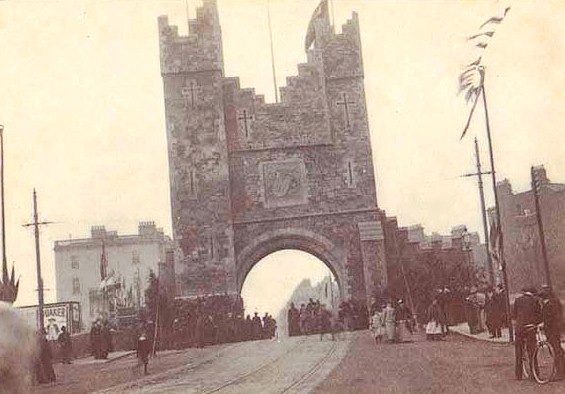
A pier had to be built for Her Majesty to disembark upon. Carpenters have worked around the clock to get it built in time. An arch was also built for Her Majesty to pass through as she entered the city from the bay. It is created like a Gothic castle and looks very regal. Never mind it’s made of wood and canvas. A stone one in such short order was out of the question. Buildings everywhere sport Union Jacks, and buntings crisscross the streets as old Dublin is dressed up for the party.

Welcoming Arch (not bad for wood and canvas, eh?)
Yesterday at 2:15 in the afternoon, the Royal Yacht, the Victoria and Albert II, dropped anchor in Dublin Bay. Her Majesty spent the night aboard. Dozens of tourists rowed boats out to get a closer peek, but only got a better look at the ship, not the Queen herself. No incidence of violence, although 100 cannons were fired over the Bay as a salute when she arrived. Last night there was a huge fireworks display which must have kept Her Majesty awake.

Priests told their flocks to boycott the welcoming ceremonies. Indeed the reception committee of city dignitaries was missing over 20 men. Although Catholics have been given back most civil rights, they are still treated as second class citizens. The Queen is the head of the Protestant Church of Ireland, so she represents both religious oppression, as well as the Head of the Empire that holds Ireland in chains. Throngs have snubbed the whole visit on both political and religious grounds.

This morning Her Majesty stepped out on the new pier and was whisked away in an open carriage. The red clad soldiers and brass bands made a fine parade. The streets were lined with cheering crowds. You would never know there was any kind of boycott. Even so I’m not sure how many showed up as an act of support and how many just came for the spectacle. I think the latter made up most of the crowd.

Queen's carriage leaving the harbour
The Queen gave a short but heartfelt speech about the brave Irish soldiers who have fought for her in the Boer War in South Africa. She came to Ireland to pay tribute to the 1000s who have given their lives to the Empire. I heard someone mutter she just came to recruit more foolish men to fight in a war that didn’t concern Ireland.

Demonstrations have been kept in check. The Irish Transvaal Committee gathered for a torchlight procession of protest last night, but were chased off by baton-wielding police officers. Mainstream media are pro-Victoria, but the nationalist newspaper The United Irishman today called Her “the Famine Queen.” Policemen seized as many copies as they could find and arrested the editor, Arthur Griffith, future founder of the Irish Political Party, Sinn Fein. He will be in jail for the next two weeks.

There are extra policemen and soldiers and personal guards everywhere. The Queen hasn’t forgotten the Irish assassin who tried to shoot her back in 1849. There is no record of any attempt on her life on this visit. She may be the Leader of the British Empire, but she is also a frail sickly 81-year-old woman. Who wants to be known as the chap that shot a great-grandmother? Just doesn’t seem sporting.

the 81-year-old Queen Victoria
Footage of Queen Victoria’s Visit to Dublin
(That’s me in the brown top hat.)

More of Queen Victoria’s visit to Dublin

More photos:
The Queen and her Indian secrtary, Abdul Karim
Her Majesty's Yacht, the Victoria and Albert II
Lands that were part of the Bristish Empire at one time or another

8.9.12

The Tea I Left Behind

Saturday, 31 March 1900 - Dublin, Ireland

I am staying at the beautiful Shelbourne Hotel overlooking St. Stephen’s Green here in Dublin. The hotel was opened in 1824 by Martin Burke. He named his hotel after William, the 2nd Earl of Shelbourne and Prime Minister of Britain (1782-83) in an effort to woo genteel customers. The register already looks like a Who’s Who of celebrities and heads of states.

Shelbourne Hotel overlooking St. Stephen's Green
I was asked to record Room 112 in particular. In 1922 Michael Collin’s will use this meeting room to draft the Constitution of the future Irish Republic. I think they may have chosen the Shelborne because during the coming Uprising of 1916, they opened their doors to the wounded and served as a hospital for both sides.

I had a bit of a shock this morning though. One of the servers, looked about 18, asked me if I would care for more tea in a German accent. I asked the fellow where he was from.

My server
“Linz, Austria.”

“How did you wind up in Dublin?”

“I ran away from home.” He scowled. “It was hell. My father beat me; my stepmother ignored me. She dotes on her little darling Adolf. Spoiled brat!”

“Doesn’t sound like a happy family life,” I agreed. “I think I would have run away, too.”

It was then the head waiter snapped his fingers. “Hitler! More tea at this table.” The boy scurried off leaving me feeling some what discombobulated.

Alois Hitler, Sr.
(as mean as he looks)
I knew Hitler is not a common name. Alois Schicklgruber, son of Maria Schicklgruber and...well, historians are still debating over who his father was. Johann Georg Hiedler was his stepfather. At 39 Alois asked permission to use his stepfather’s name and changed the spelling to Hitler. Alois married Anna Glasl-Hörer but had children with his two mistresses who he eventually married, including his cousin Klara with whom he had Adolf. (Sounds like a bad soap opera.)

There are a few records of other Hitlers not related to Adolf even though Hiedler is the more common spelling. Surely this lad isn’t related to THE Adolf Hitler. I pulled out my computer I have disguised as a pocket Bible and proceeded to “read the Good Book,” checking my historic records.

Oh my word! Apparently Alois’ eldest son, Alois Jr. is currently working at the Shelbourne as an apprentice waiter and...this isn’t good...will be arrested for theft soon and sent to jail for five months. Best watch my valuables, eh?

Alois Hitler, Jr.
Future not looking wonderful for Alois; he’s a chip of the old block it appears. He will be arrested on other occasions. He will meet a nice Irish girl named Bridget, elope to London, have a son in Liverpool and then desert them for a gambling trip in Europe and marry another lady in Germany, while still married to Bridget. Fortunately Alois Jr. will stay out of politics, only using his brother’s power to acquire the position of barkeep to the storm troopers at his tavern.

Bridget and their son William Patrick will carry on without Alois. In 1939 the two will go on a lecture tour to America speaking against Adolf, and be stranded there with the outbreak of World War II. Just as well, their digs back in Liverpool were destroyed in the Blitz. William will join the U.S. Navy and change his last name to Stuart-Houston. This Hitler will have a much more stable family life, raising four boys. None of them will have children.

William Patrick Hitler Stuart-Houston
I stared at the tea Adolf Hitler’s brother had poured me, feeling slightly nauseous. I know the Third Reich and the Holocaust are not Alois Jr’s fault. He played no part in them. However he did nothing to oppose his brother like his son had, but took advantage of Adolf's position for his own profit.

I left the tea without drinking it. I think I’ll have breakfast at that restaurant with the Irish name across the street from now on.

6.9.12

An Oversimplified History of Dublin

Thursday, 29 March 1900 - Dublin, Ireland

Map of Dublin circa 1900
Dublin is the largest city in Ireland--its industrial and political center. It’s also the least Irish of her towns since it’s been a dumping ground for cocky invaders for over 1,000 years. The city itself was founded back in the ninth century by marauding Vikings as a camp for their raiding parties.

Funny thing about Ireland is it’s hard to not be swept up by her culture and lilting accent. The Vikings slowly became Irish and turned to commerce, stealing from the natives with high prices rather than by the sword. The local Celts converted the Norsemen to Christianity and things settled back to normal.

In 1155 Pope Adrian, the only English Pope, “gave” Ireland to the Norman conquerors of England. Ireland didn’t agree with this arrangement so the Normans had to take it by force. There was one problem. Ireland at this time had a unique political system. The country was divided up into numerous small kingdoms. These kings pledged allegiance to a High King. However outside of token recognition, the High King was ignored and the lesser kings did as they pleased. So if you conquered the High King of Ireland, all you really conquered was his own little kingdom and not all the lands supposedly subject to him. The power struggle between Normans and natives see-sawed back and forth until Ireland became a patchwork of Gaelic and Norman kingdoms. By the 1300s Normans were Norman in name only, having intermarried with the natives and adopting their culture and language. (I should point out that many leaders of the later Irish Rebellion had Norman names. Indeed “Fitz” is now considered as Irish as “O” or “Mac.”)

In 1366 the English Crown created the Pale (literally “fence”.) It was the area around Dublin, the only part of Ireland that the English had any real hold on. In the Pale, intermarriage between Irish and English, as well as the Irish language, dress and customs were forbidden. The English Monarch became the High King of Ireland, which meant the rest of Ireland pretty much ignored him. Slowly the fence was breached and even the Pale became Irish.


Queen Elizabeth I had had enough. Pope Adrian had given her family Ireland so she felt it was hers. She would finish what the Normans started. So began the long drawn out and complex process of conquest enacted with numerous battles and occasional compromises that really only ended with the Act of Union in 1801. As Scotland and England were united as Great Britain, Ireland was united with Britain to form the United Kingdom. And peace finally came to Ireland...or has it?

The University of Dublin has asked me to come to Dublin to cover Queen Victoria’s visit. They also want me to record the reaction of the people to this very controversial event. Ireland is getting fed-up with this shotgun wedding and wants a divorce. Right now most folks are just pushing for self government as a Dominion like Canada or Australia. Others want a clean break as a totally independent country. I can already feel the dark cloud of revolution in the air that will erupt in 1919. This may not be the best time for an Englishman to be in Ireland, but the University of Dublin assured me there was no records of Englishmen being lynched, so I should be safe enough.

Dublin as she looks in 1900
I also plan to record the city architecture and the culture of Ireland. The Irish are known for their hospitality. If I’m polite conduct myself as a good guest I should be fine. If anyone does get hostile I will tell them I am here to study the magnificent manuscripts of the Irish Golden Age. That should appease any patriotic Irishman.

Besides they are a nation a tea drinkers, so we should get along just fine. (Yes, Ireland drinks more tea per capita than even England!)